
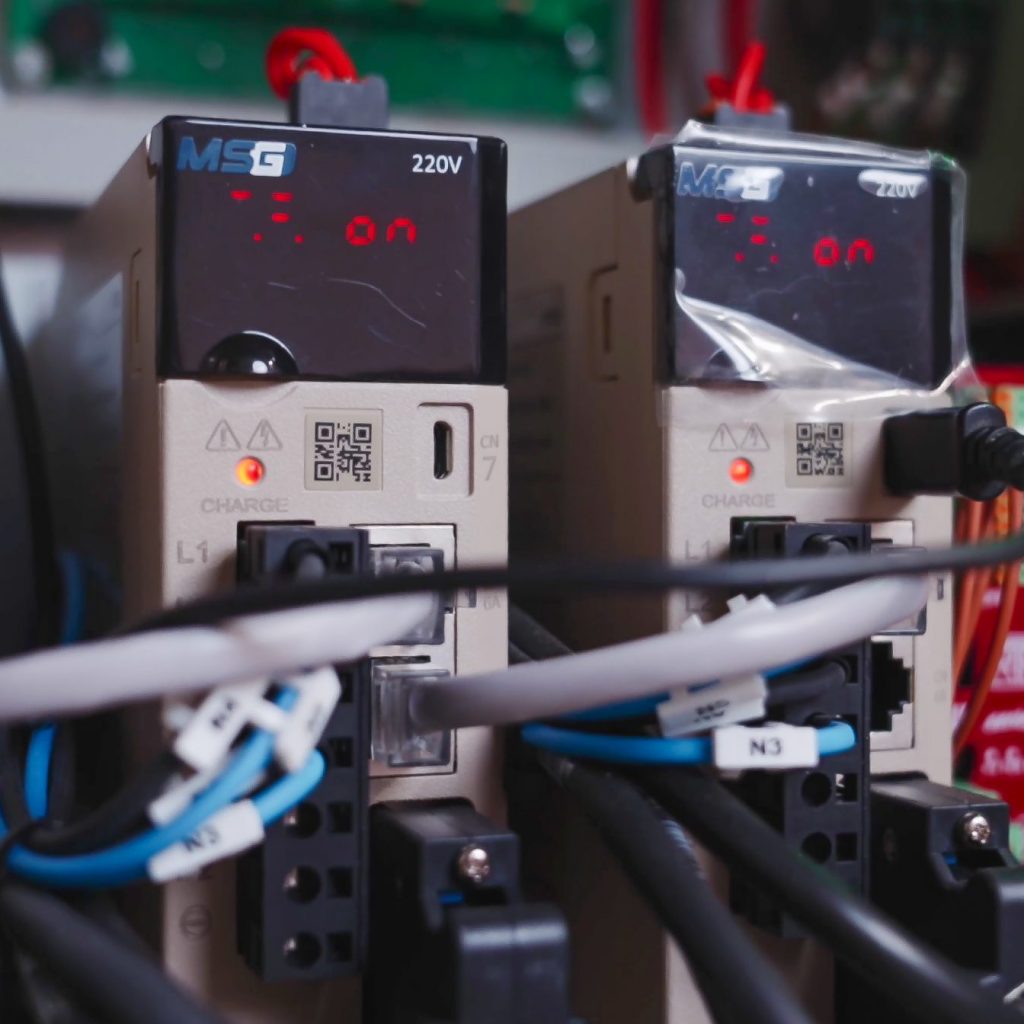
How Etibal optimized its industrial automation to improve production
Etibal, a manufacturer of industrial weighing and labeling machinery, develops equipment that operates in environments where continuity and efficiency are critical.
For years, the automation of its machines was built with different electronic suppliers. Each component fulfilled its function, but the whole was not conceived as a unified system.
Over time, this fragmentation began to create operational friction:
- Less agile production processes
- Greater complexity in maintenance and repairs
- Difficulties in ensuring consistent technical service
The challenge was not isolated. It was at the foundation of the system.
An approach beyond components
The solution was not about replacing one specific element.
It was about rethinking the automation architecture as a whole.
In this context, TGM proposed an approach focused on simplifying and unifying the technological foundation, supported by MSG’s automation ecosystem.
Unifying control, supervision, and motion within the same logic.
More than a sum of components, the goal was to build a coherent architecture.
From a fragmented architecture to a more coherent foundation
By reducing fragmentation and working on a common foundation, the way the machines operate begins to change.
Integration stops being a critical point, maintenance becomes more predictable, and solutions can evolve with greater coherence between projects.
But the impact goes beyond operational efficiency.
It has to do with the ability to standardize, replicate, and scale without increasing complexity in each new machine.
A change that is already reflected in production
The result is visible in daily operations.
But what matters is not only the impact, but how it was achieved and which decisions made it possible.